
The Yi Jing (I Ching) hexagram 24, The Return (fu 復), is associated with the winter solstice. It illustrates the beginning of the return of the light, the return of the yang after its total withdrawal. The image of the hexagram ䷗ shows one yang line emerging at the base. The upper trigram has three yin lines and is called kun (坤), the earth ☷, the lower trigram is thunder ☳, the arousing, zhen (震), and represents the stirring of the yang in the depths. Read more
Blog
the symbolism of numbers
The following is an extract from the introduction of a new book by Elisabeth Rochat de la Vallée, The Symbolism of Numbers in Traditional China.
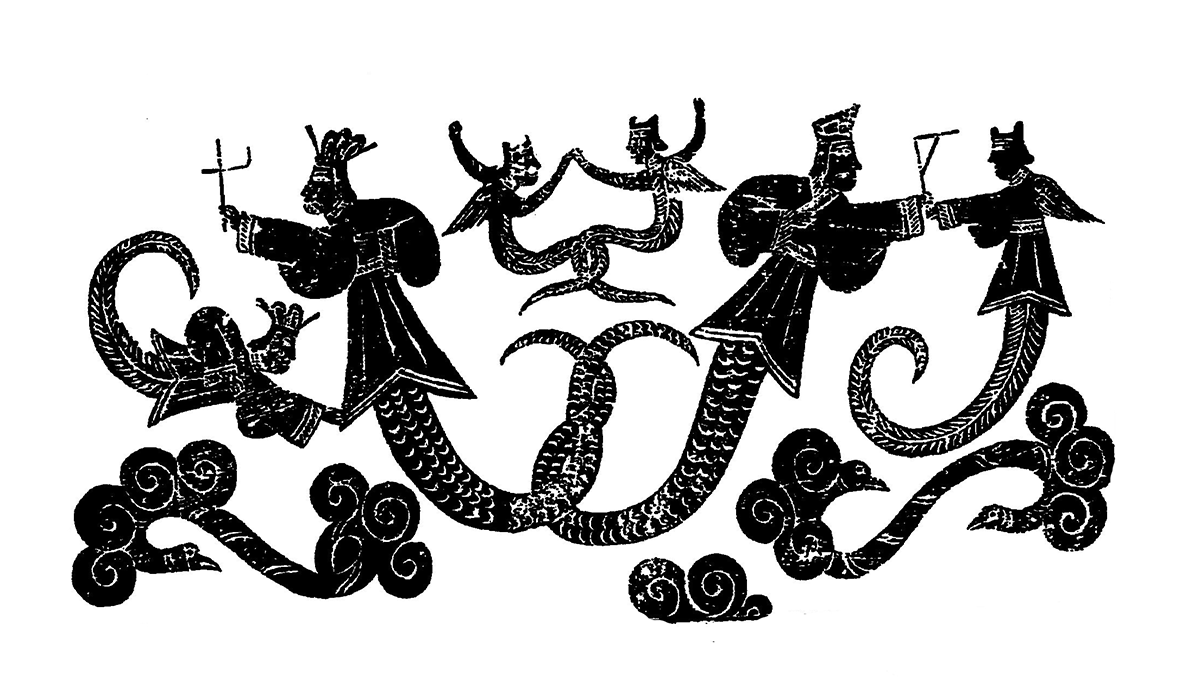
 Numbers, expressions of One
Numbers are agents of the production of the world, from the heart of the One. They symbolize an organization which is perceptible to us and understood by us, and which the human mind imposes on the universe in a process of constant transformation. They function as the operators of cosmic life in perpetual evolution. Read more
YANG SHENG 養 生 NOURISHING LIFE
Yang sheng (養 生) is term that has become familiar to us in the context of various ‘nourishing life’ practices. It is an ancient term, and specific yang sheng texts have been found which date back to the 3rd and 2nd centuries BCE. Some of these texts specifically stress diet, exercise and sexual practices which are considered to enhance the vitality and possibly even lengthen life. But the early chapters of the Neijing suggest that it is in the ability to observe what is appropriate at a particular time and for a particular individual that the real art of nourishing life resides.
Yang (養) is to nourish, and includes the most common character for eating food shi (食), but it has a wider meaning than simple nourishment for the body – it is to nurture, to care for, to maintain, not only physically. It is commonly used to describe the way parents take care of their children, and it includes the idea of education, a nourishment of the mind. It is found in early Daoist texts, such as the Neiye, for nourishing the heart/mind, and in Confucian texts for building character. Read more
heaven earth, yin yang
yin and yang in huainanzi chapter 3
‘When Heaven and Earth were yet unformed, all was ascending and flying, diving and delving. Thus it is called the primal beginning. The dao begins in the nebulous void. The nebulous void produces space-time; space-time produces the primordial qi.
A shoreline (divides) the primordial qi. That which is pure and bright spreads out to form heaven; the heavy and turbid congeals to form earth. It is easy for that which is pure and subtle to disperse, but difficult for the heavy and turbid to congeal. Therefore, first heaven is completed, and then earth fixed.
The combined essences of heaven and earth produce yin and yang. The successive essences of yin and yang cause the four seasons. The scattered essences of the four seasons create the ten thousand things.’ Read more
the triple heater and ‘no form’

The Nanjing (Difficulty 25) states that the triple heater (san jiao 三 焦) and master heart (xin zhu 心 主) have a ‘name but no form (you ming wu xing 有 名 無 形)’. This statement has been debated throughout the centuries, earlier commentaries, including Sun Simiao, suggesting that the use of ‘no form’ (wu xing 無 形) within the Nanjing is close to the meaning found in early Daoist texts – referring to that which is un-manifest, coming before physical manifestation – and maybe holding the qi patterning for future manifestation. They imply that the triple heater and heart master have no physical substance but are functions of qi. Nanjing 8 and 66 make a connection between the triple heater and ming men (life gate, or the gate of the unfolding of life), Difficulty 66 suggesting that the three heaters are ‘the agents for the distribution of original qi (yuan qi 原 氣)’.
Communication and circulation 通
There are many characters used for the vital function of free-flow of blood and qi throughout the body, but the most important and commonly used is tong (通).
The character tong (通) describes any kind of communication which is free from obstruction; it is particularly used for the spreading and free movement of qi, but can describe communication between people as much as free-flow within the organism. In classical Chinese it is to open the way, to open dialogue, to allow the mingling of different things, ideas, people. It is to give free access to something; to penetrate and to permeate. Read more
apologies
Recently our server crashed and we lost the last two blogs. They have now been re-instated. I was particularly concerned that the tribute to our great friend Tim Gordon disappeared.
Tim’s memorial service will take place this Friday (July 7th) at 2pm at Conway Hall, Red Lion Square, London WC1
Tim’s Preface to Jing Shen
On the translation of Jing Shen – chapter 7 of the Huainanzi

Our group has been meeting for more than twenty years. The thrust of our work has been the joy of learning about translation from Chinese helped by our illustrious guides, and the insights we gain from the process of producing a translation paying scrupulous attention to the original Chinese characters and text. Read more
Tim Gordon

Tim Gordon has been a great supporter of Monkey Press and was involved in the earliest seminars of Claude Larre and Elisabeth Rochat de la Vallée in the UK. His years as a medical doctor and researcher made him sharp inquisitor into the meanings of the Chinese medical texts, and Father Larre would often call upon him to clarity certain concepts in the light of modern science. His voice is occasionally heard in the early Monkey Press transcripts of the seminars. Read more
yuan – source 原/元
Two characters are found with the meaning of source or origin, and both have the pronunciation of yuan – though with a different toning. Both characters can be found within the expression yuan qi, and most sinologists suggest that they are interchangeable in this context. Others suggest that yuan (元) should be translated as origin – yuan (原) as source.
Etymologically, yuan (元) is to be above everything else, the most important, the highest principle. It is found in ancient oracular inscriptions, where it is often used in relation to the original ancestry. It is metaphysical and obscure, reflecting the mysterious, deep origins of life, the universe and everything. Read more